
Most people do not arrive at Tattsa because they are searching for stillness.
They arrive because something in them has grown tired.
Tired of holding itself together.
Tired of functioning through noise.
Tired of explaining what cannot always be explained.
Sometimes the body says it first.
Through fatigue.
Through breath that never settles fully.
Through sleep that does not feel like rest.
Through a nervous system that remains alert long after the day is over.
And slowly, somewhere along the way, many people forget what it feels like to truly slow down.
Tattsa is not built around urgency.
It is not a place that asks the body to perform healing quickly, or the mind to immediately “let go.” What matters here is not speed, but safety. Not force, but listening.
Some people come here carrying stress.
Some come carrying pain.
Some come carrying trauma the body still responds to long after the mind has learned to move forward.

Long periods of overwhelm.
Grief moved through too quickly.
Years of staying alert, adapting, functioning, pushing through.
Sometimes the mind has already found language for what happened.
The body has not.
It may still brace.
Still anticipate.
Still struggle to settle fully into rest.
And often, before anything else, what is needed is not force or analysis—but the experience of safety without demand.
That itself can be unfamiliar.
What happens here is often quiet.
A person sits.
Breath changes slightly.
The shoulders lower without instruction.
Silence returns to the room—not as absence, but as space.
There are no fixed routines imposed onto every person in the same way. Sessions are not approached as formulas. The body responds differently depending on its history, its pace, its level of safety, and the amount of holding it has learned over time.
Some sessions involve stillness.
Some involve conversation.
Some involve touch.
Some involve simply allowing the nervous system to stop anticipating for a while.
The work at Tattsa may include craniosacral therapy, fascial work, nervous system regulation, and other touch-based approaches that support the body’s ability to slow down, settle, and respond differently over time.
But the session is never reduced to technique alone.
What matters most is not only what is done, but how the body experiences being met.
At Tattsa, listening matters.
Not only listening to words, but listening to posture, breath, pauses, fatigue, pacing, and the subtle ways the body communicates long before language arrives.
Sometimes what is most needed is not intervention, but space.
Not every discomfort needs to be immediately corrected.
Not every silence needs to be filled.
Not every response happens instantly.
The body has its own timing.
And often, when it is finally met without pressure, it begins responding in ways that cannot be forced.
Sometimes, as the body settles, people also begin to notice something else returning—clarity.
Not necessarily answers, but the ability to hear themselves more clearly beneath the noise, urgency, and constant adaptation of daily life.
At times, what changes is not only pain or tension, but perception itself:
how a person experiences their body, their decisions, their relationships, their pace, and the way they move through life.
Sometimes clarity does not arrive through thinking harder, but through the body no longer needing to stay in constant defence.
Touch, too, is approached differently here.
Not as technique alone.
Not as performance.
Not as something done to the body.
But as a way of listening.
The body understands safety differently from the mind. Long before we explain ourselves, the nervous system has already responded to how it is being met. Sometimes a person may not even realise how much effort has gone into bracing, guarding, or holding—until, for a brief moment, that effort softens.
The body often continues responding to experiences long after the moment itself has passed.
Tattsa is not trying to separate the body from the rest of life.
How we live matters.
The pace we keep.
The spaces we inhabit.
The amount of noise we move through.
The rhythm of our days.
The quality of our rest.
The absence or presence of touch.
The ways in which we have learned to stay alert.
All of this shapes the nervous system.
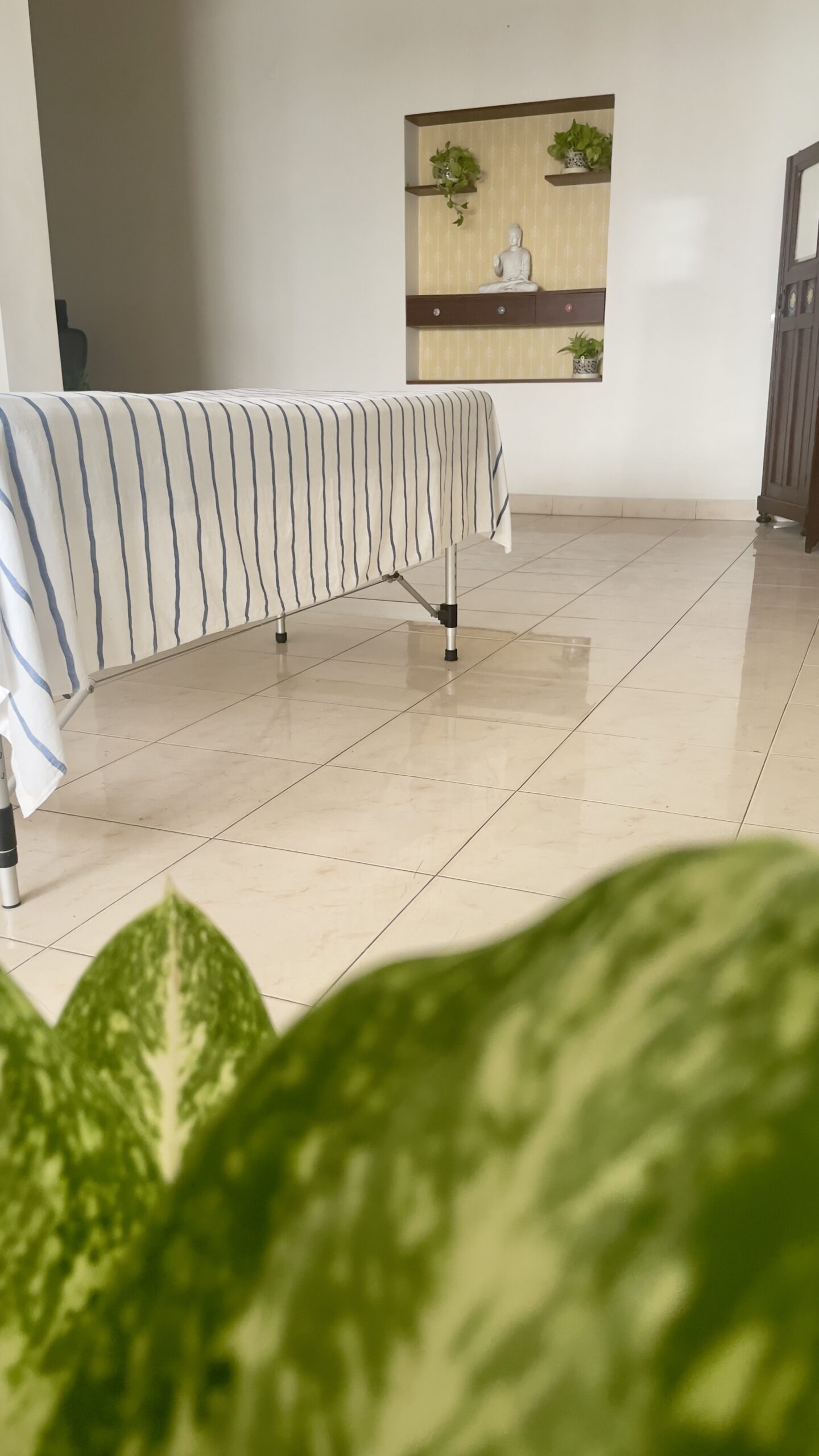
And so, the space here is kept intentionally simple.
Natural light.
Trees moving outside.
A quieter pocket within the movement and pace of Chennai.
Time that is not tightly compressed.
One person at a time.
A pace that allows the body to arrive before the session begins.
Nothing dramatic needs to happen.
Sometimes healing begins quietly—when the body no longer feels the need to defend itself quite so much.
And sometimes, before anything changes physically, a person simply experiences what it feels like to be met without demand.
That, too, can be a beginning.