
Earth has always been spacious.
Kaatru varum.
Velicham varum.
Nilam eduthukkum.
Air arrives.
Light arrives.
The soil receives.
There is space to walk.
Space to sit.
Space to just breathe.
But slowly, we have begun moving away from this expanse—rising into boxed apartments, living inside sealed rooms of private air. We measure square feet, check ventilation, discuss cross-breeze, negotiate balcony size, and slowly get used to living above the ground that once received our footsteps.
There was a time, not very long ago, when our towns rose differently.
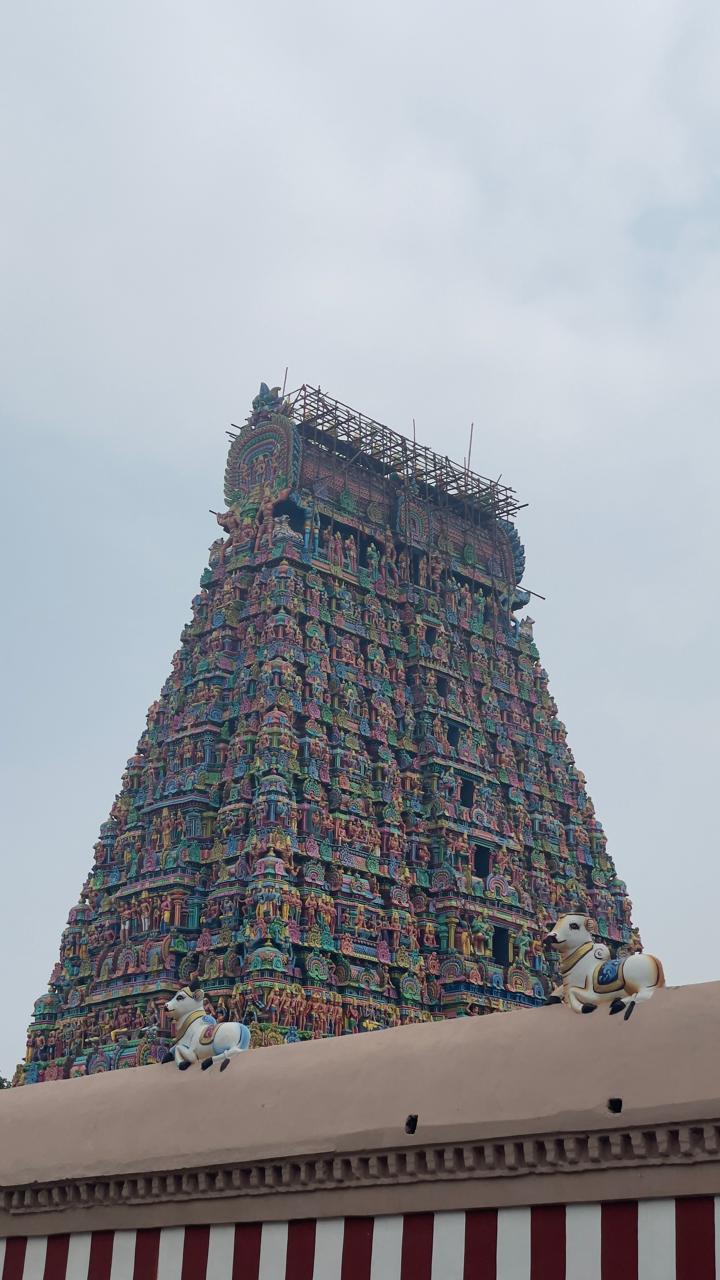
In many South Indian settlements, houses were rarely built taller than the temple gopuram. Not because there was a written rule. Not because someone would fine you. But because there was an understanding that height could be left for something shared.
The vertical was not taken by the private.
It was offered.
The gopuram stood taller than the rest of the town—not only as a place of prayer, but as something visible from almost anywhere. A point of orientation. A quiet reminder of what the town was arranged around.
Temples often held more than the sanctum.
Temple tanks supported groundwater.
Granaries followed farming cycles.
And in some traditions, the kalaśam carried vedha nel—seed varieties preserved not for eating, but for planting again.
If a crop failed, if a certain variety disappeared due to pests or seasonal damage, these seeds could be brought back into cultivation, restoring what was lost.
In this way, the temple seems to have held a quiet form of continuity.
As the tallest structure in the settlement, the gopuram—with its stone mass and metal kalaśam—also formed the highest conductive point in the area. During lightning activity, such high points are known to attract electrical discharge. While not engineered like modern lightning rods, they may have drawn lightning toward the highest point, away from surrounding lower homes.
Most houses were built low, often around open courtyards.
Wind could move freely.
Heat could dissipate into the ground.
The eye-line met trees, temple towers, or open sky.
The horizon was always present.
Today, many of us live several floors above the soil.
Apartments enclose us within partitioned interiors where air is circulated mechanically and light enters through fixed openings. The horizon is replaced by the next building. Soil becomes something we visit occasionally, rather than something we live upon. Wind arrives through vents.
Over time, living in such compact or elevated spaces can require the body to adjust.
We learn to move carefully.
To share walls.
To keep windows closed.
To wait for lifts.
Posture adapts.
Breath becomes measured within boundary.
The eye grows used to resting on near surfaces.
The horizon—once wide—arrives in fragments.
When the space around us narrows, the mind slowly learns that geometry.
Movement becomes careful.
Thought begins to organise itself around boundary.
The sense of expanse that once arrived naturally—from sky, wind, open ground—now has to be imagined rather than felt.
Over time, the mind too can begin to live within smaller rooms.
And slowly, this way of living begins to echo through life itself—quietly shaping how we move, how we think, and how much space we allow ourselves to feel.
Brown soil footpaths that once received our steps are now laid over with tar.
Contact with the ground becomes occasional.
Bathing in fresh water drawn from wells is replaced in many places by treated supply—stored, chlorinated, timed.
The dark sky that once held stars is now lit by streetlamps, signboards, and passing headlights.
Sleep, which once arrived with nightfall, now unfolds amidst the low hum of generators, the presence of Wi-Fi routers, and mobile signals. Even rest carries the rhythm of activity.
Movement continues—through devices, through networks—long after the body has lain down.
In such interiors, the nervous system may begin to track what is available:
air,
privacy,
access,
water.
A subtle counting can take hold—not always consciously, but physically.
And yet, beyond the enclosure, the earth continues to offer air, light, shade, soil, and wind in quiet abundance.
Settlements were once arranged around shared structures that held ecological roles—water below, seed above, time within.
Height was not restricted.
It was relinquished.
Today, the vertical has multiplied.
The horizon has narrowed.
Over time, the mind learns the language of restriction, even while nature remains generous and expansive.
And yet the earth has not become smaller.
Only the spaces we live within have.
Height was not governed.
It was entrusted.