
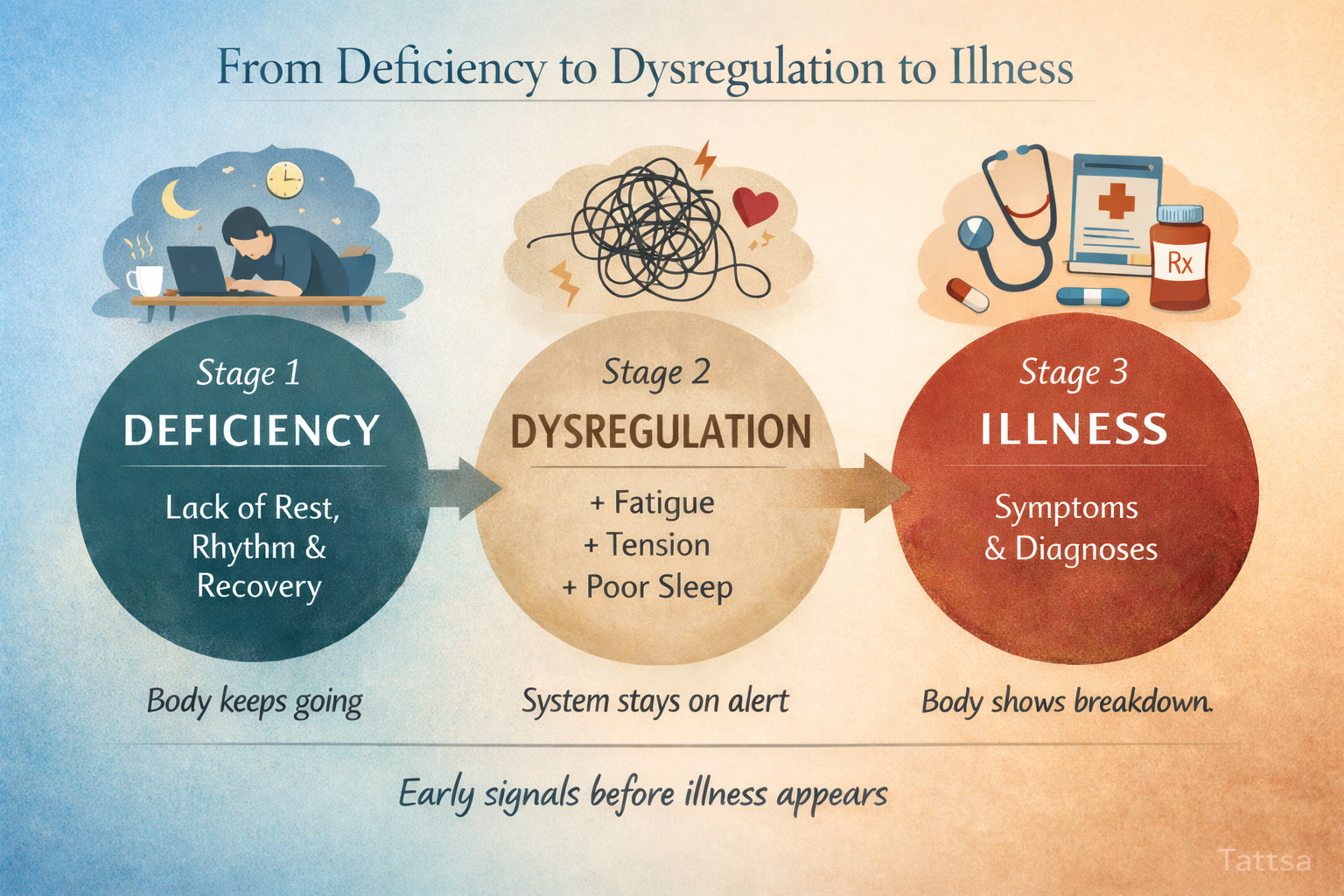
In reality, the body usually changes much earlier — quietly and gradually.
Long hours of sitting.
Irregular meals.
Poor sleep.
Constant screens.
Persistent mental engagement.
These patterns are now ordinary. Most people live this way without feeling unwell.
Yet over time, something subtle begins to shift.
When we are less attuned to ourselves, small changes go unnoticed — much like the way perception and narrative shape what we see before we recognise it in the body.
The body starts to experience deficiency — not necessarily of nutrients, but of rest, rhythm, and recovery.
Deficiency Is Often Invisible
The human system is designed to adapt. It compensates for long periods by tightening, staying alert, and borrowing energy from tomorrow.
Outwardly, life continues.
Internally, the nervous system remains active — even during rest.
The body has its own language long before we begin to interpret it consciously, as explored in when the body speaks before we do.
This early deficiency is rarely recognised because nothing feels “wrong.”
Sleep still happens.
Work still gets done.
Function remains intact.
But the system is no longer returning fully to neutral.
Rest Is Not the Same as Stopping
Many people stop activity without ever truly resting.
Screens replace movement.
Weekends remain stimulating.
Mental engagement rarely pauses.
Physiological rest occurs when the nervous system senses safety. In this state, the body naturally shifts toward repair, digestion, integration, and renewal.
There is a deeper knowing in the body — a wisdom that often precedes our mental awareness, reflected in the body knowing long before the mind arrives.
When this state is absent, deficiency continues — quietly.
When Dysregulation Hardens Over Time
If this state continues long enough, the body begins to adapt around it.
What was once a passing strain becomes familiar.
What was once temporary becomes the background.
The system learns to live without ease.
Only later does this quiet adaptation take a clearer form — something that can be named, measured, or treated.
By the time that happens, the body has already been holding this way for a long while.
Where Gentle, Body-Led Work Fits
At Tattsa, the work is slow, quiet, and attentive. It does not aim to fix symptoms or override the body’s intelligence.
It offers the nervous system an opportunity to settle.
As the system slows down, the body begins to reorganise on its own terms. Breath changes. Tension patterns soften. Internal rhythms adjust.
This aligns with Tattsa’s vision — a space for stillness, listening, and organised rest.
Many people arrive not because something is broken, but because something no longer feels sustainable.
Listening at the stage of deficiency — before patterns harden into something more entrenched — allows the body to return to balance earlier, and more gently.